Friday, March 11, 2011

La Phonogalerie


Gramophones and stacks of records at La Phonogalerie, Paris.


I went on a guided tour this week of the "Phonogalerie", a centre for gramophones, records, and all things to do with the history of recorded sound. When you walk into Monsieur Aro's "Phonogalerie", a large light-filled showroom near Pigalle Metro, the first thing that strikes you is the sheer number of beautiful gramophones. The horns, the gramophone's most prominent part, are everywhere, attached to machines, stacked in piles, or encased in elaborate wooden cabinetry. They are mostly made of metal, but some are wood, and there is even a glass one. Some are large, flaring out like the petals of a petunia flower. Others are slim and streamlined, like tall pointy witch hats. One model, used at a World's Fair, did not have a horn, but instead, had many headphones attached. 

A wax cylinder gramophone with many headphones (white dangling tubes).
Monsieur Aro quizzed us: Who was the first person to invent a machine to record and play back sound? Everyone else on the guided tour was silent so of course I blurted out “Thomas Edison.” Wrong! It was not the American Edison, said M. Aro with a satisfied smile, but the Frenchman Charles Cros who was the first person to invent such a machine. Cros had written a note to the French Academy of Sciences, explaining the concept, but was so disappointed with the lack of interest that he then moved on to other projects. 

A glass horn. The beige cylinder to the lower right behind the horn is the wax cylinder used to record and reproduce sound.
           Edison was the first to patent his invention, and to make it commercially successful. We got to listen to music from the early 1900s recorded on a wax cylinder, before the invention of flat recording discs. We also heard music from the “Regina Hexaphone” jukebox (a nickel a song), and a song from a vinyl record played on a gramophone. All of us sighed that it brought back many happy childhood memories of listening to records.

Thursday, March 3, 2011

Belleville

How I wish I had brought my camera with me today, it was so sunny, and the sky was so blue. I would have taken some photos of Belleville, Paris' old Chinatown in the 19th arrondissement, where I had lunch and bought groceries today after woodworking class. Bet you can’t guess what I had for lunch at the place with the cleverly obscure name, Restaurant Ravioli, at 47 rue de Belleville. The ravioli, or potstickers, are hand-made, including the wrappers, as I have walked by during off-hours and seen the workers sitting at a floury table, rolling out circles of dough at lightning speed, filling, sealing, done. Today I had tofu, shitake mushroom and chive ravioli, small, pan-fried and crispy on the bottom, tender and tasty with just enough chewiness everywhere else.

I couldn’t leave without getting some essential groceries: steamed pork buns, roast duck, and dried black beans. Black beans are amazingly difficult to find in Paris, and after looking around in many different areas of the city, in all kinds of gourmet, ethnic, and health food stores, I finally found some in Belleville, on the bottom shelf of a small display of beans in the basement of a very modest store on a side street near the Metro.

 Nobody in this town ever has change for bills bigger than 5 euros, so I’ve gotten into the habit of always trying to pay with exact change. I was at the checkout, painstakingly counting out my coins, when a young Asian woman rushed over, clutching a gingerroot and two boxes of strawberries. She seemed agitated, swayed side to side, and held her groceries tight against her body. She spoke in Mandarin and told the cashier her stomach really hurt, and could she please pay right after me, and before the next person, a middle-aged Caucasian man with a full grocery basket. The cashier considered her request, then replied in Mandarin that she should really ask the man, who was next in line. “But I don’t speak French!” said the young woman. The cashier turned to the man, asked in French if he would mind letting the young woman go first, and he said it was fine. As the cashier rang up the gingerroot and strawberries, she told the young woman: “I hope you understand why I said we had to ask him first. We have to be a little careful, we don’t want them accusing us of only looking after our own people!”

Wednesday, March 2, 2011

A Close Call on the 91 Bus

He was big, tall, with a hugely protruding belly, and he was so close I could smell his bad breath. I didn’t dare look up. I didn’t want to see his ugly mug. This is exactly the reason why Mister K prefers to walk or bike, instead of taking public transportation. I was musing about how to describe the unpleasant situation of being crammed into a packed bus, sharing air space with bulky individuals emanating noxious fumes.  Would I use the phrase “a miasma of stench”? Or would I use a different image, like “inhaling a cloud of germs from other people’s intimate parts”?

My purse was slung diagonally over my shoulder, hanging at my waist, and I felt a slight nudge there, faint as a whisper. I had the passing thought that nobody better be trying to pinch my bottom. The bus stopped, people got off, and some space opened up in the aisle near George. I moved to the aisle, towards George so we could be sure to exit together later, but there was a teenage girl standing in the way, chatting with her seated friend. I said “Pardon,” and was getting ready to move past her when all of a sudden the big fat guy lumbered into the aisle, pushed past me, separating the teenager from her friend, and then stopped right there, like a stolid elephant rooted to the spot. The teenager and I exchanged “some people are so rude” glances. In the meantime, other people had come onto the bus so I was now sandwiched between the fat guy and the invading mass of new passengers. Again, I felt a slight fleeting pressure near my waist, but it was so slight, we were wedged in so tightly, and I was busy thinking about how we had to get off at the next stop and I had to be sure to catch George’s eye so he wouldn’t forget to get off too. It was hard work wading through the crowd to get out, and as soon as I stepped off the bus, I looked down at my purse. The zipper was halfway undone, and I am absolutely 100% positive that it had been completely done up when we had gotten onto the bus. In that moment, looking at the zipper, I knew, I knew for certain, that the big fat guy had been trying to pickpocket me.

It explained everything, the odd microsecond nudges as he tried to push the zipper along, and his sudden febrile lunge into the aisle that ended so abruptly as soon as he was smack dab right next to me. Luckily, nothing was taken, my wallet was still there (too wide and bulky to lift out even with the zipper half undone), and no money was taken (wallet very deep, very little money in it, and the billfold area was stuffed full with junk like old receipts and coupons anyway). A happy ending!

Wednesday, February 23, 2011

Dirty Bit: Belgian Endive

Soil grown Belgian endive from Agnes' farm.
Note dirt on leaves--a good sign.
It’s true. Dirty endives taste better. Belgian endives grown in dirt taste better than those grown hydroponically. I never even knew there were two ways of growing Belgian endive, let alone that there might be a difference in the way they taste, until one fine day at the local greengrocers, Convention Les Halles.  There I was, waiting in line. The woman in front of me, let’s just call her Madame X, had piled up a mound of delicious looking fruits and vegetables on the tiny counter. The cashier, a middle-aged woman who often wore fingerless gloves to fend off the cold wafting in from the open store front, held up a bag of pale, torpedo shaped Belgian endives.
“What kind are these?” asked the cashier.
“What kind? I don’t know, are there different kinds?” asked Madame X.
“There’s the regular kind, then there’s ‘pleine terre’. The ‘pleine terre’ are more expensive.”
Madame X took her bag of endives and went back to the ‘pleine terre’ crate, which was stamped on its wooden side with a picture of a farmer and a plow. She inspected it, dumped the endives back in the crate, and marched back to the cashier.
“I’m not paying 4 euros a kilo for them, that’s twice as much as the other ones,” huffed Madame X. The cashier shrugged and rang up the rest of the groceries.

            After Madame X had stomped off, I asked the cashier what the difference was between the two kinds of endives. One was grown hydroponically, she told me, and the other was grown in soil. The soil made them less bitter and tastier, she said. Of course after that I had to try some ‘pleine terre’ endives.

            My favorite farmer in the local market is Agnes. You won’t find kiwis and pineapples at her stand; she is a real farmer, and only brings what she has grown or foraged. This weekend I tried her Belgian endives, grown in soil, and they are the sweetest, tastiest, least bitter endives I have ever tasted. The soil grown endives from the local greengrocer are also less bitter and tastier than hydroponic endives, but Agnes’ are the best. The Belgian endive, also called French endive, or witloof (from ‘white leaf’), is Cichorium intybus. It is the same plant whose roots can be roasted and used as a coffee substitute, chicory. 

Wednesday, February 16, 2011

Val Thorens

Fred enjoying the view.


It’s winter break and we are at Val Thorens in the Alps.  It only took one day on the bunny hill with Mister K for George to learn how to snowboard. Everyone can snowboard now, except for me. The thought of both feet strapped in and immobilized on a board does not appeal to me. I’ll stick with skiing, inelegant though I may be. Lots of Dutch, Swedes, and Russians here right now. There is some snow in town, but not a lot. Kind of sad, to have so little snow in mid-February at 2300 m. It’s a good thing we didn’t go to a town lower down. The best sight so far, other than the boys snowboarding and sledding on their boards, is beehives at 3000m.


Wednesday, February 9, 2011

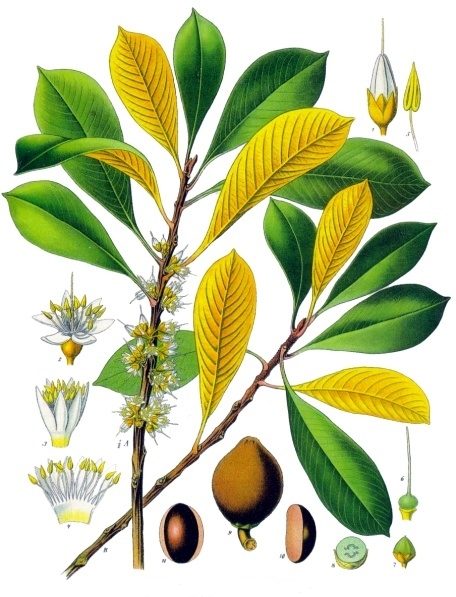
Gutta-percha


Palaquium gutta, source of gutta-percha latex
(from Köhler's Medizinal-Pflanzen)

"I want to say one word to you. Just one word. Plastics." But long before Mr. McGuire uttered these immortal lines from the 1967 film 'The Graduate,' and long before the advent of plastics, there was gutta-percha.  Isn't that a great word? I just learned it from a great book I am reading, "Science: A Four Thousand Year History," by Patricia Fara. Perhaps you already know that gutta-percha is a natural latex made from the sap of the tropical tree Palaquium gutta, and that its name comes from the Malay 'getah perca,' which means 'percha sap'. Gutta-percha was hugely important in its time, as it was used to insulate undersea telegraph cables, including the first trans-Atlantic telegraph cable. Nowadays, polyethylene plastic insulates these cables, and gutta-percha has been relegated to other uses, such as for root canals. Ouch. 

Wednesday, February 2, 2011

Stinky Cheese: Sablé du Boulonnais

Sablé du Boulonnais cheese from Beillevaire cheese shop in Paris
(http://www.fromagerie-beillevaire.com/boutique/1-fromage/114-sable-du-boulonnais.html)
When it's relentlessly grey and cold outside, and when you have to huddle by the heater to keep your fingers warm enough to type, then you know it's time for some stinky cheese therapy. Julie M. organized a great trip to the Bellevaire Fromagerie in Belleville, where we got to taste several cheeses, including this one, a pungent Sablé du Boulonnais from Boulogne-sur-Mer on France's northern coast. It's a raw cow's milk, washed rind cheese, which automatically means smelly, and this one has been washed with "bière blanche de Wissant," or "Wissant white beer." This is a beer made with unmalted wheat, spiced with coriander and orange peel.  Imagine a month of being rubbed down regularly with this spicy beer, and then being rolled in fine bread crumbs at the very end to trap all those enticingly fetid aromas. Perhaps the farmers around Boulogne-sur-Mer have a view of the nearby white sand beaches as they milk their cows and dream about the next batch of cheese?

The taste is unexpectedly sweet and mild compared to its smell. French descriptions of the cheese often include the words "sensual" and "feminine." Only the French could associate sex and beautiful women with stinky cheese! Jerôme, the cheesemonger, told us that the Sablé's cheese maker was originally an engineer. In his mid-40's, in the throes of a full-blown mid-life crisis, he decided to learn cheesemaking from scratch. He quit his job, spent a year bicycling around France, visiting cheesemakers throughout the country and learning the profession, and then took over his grandparents' ruined farm near Boulogne-sur-Mer. Many, many years of hard work later, we all get to enjoy his Sablé du Boulonnais.