Wednesday, February 16, 2011

Val Thorens

Fred enjoying the view.


It’s winter break and we are at Val Thorens in the Alps.  It only took one day on the bunny hill with Mister K for George to learn how to snowboard. Everyone can snowboard now, except for me. The thought of both feet strapped in and immobilized on a board does not appeal to me. I’ll stick with skiing, inelegant though I may be. Lots of Dutch, Swedes, and Russians here right now. There is some snow in town, but not a lot. Kind of sad, to have so little snow in mid-February at 2300 m. It’s a good thing we didn’t go to a town lower down. The best sight so far, other than the boys snowboarding and sledding on their boards, is beehives at 3000m.


Wednesday, February 9, 2011

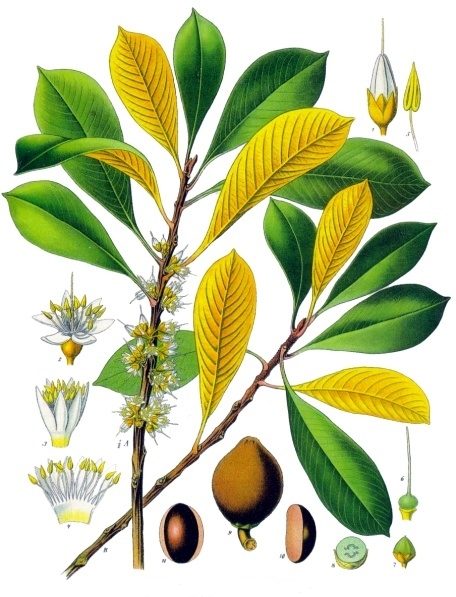
Gutta-percha


Palaquium gutta, source of gutta-percha latex
(from Köhler's Medizinal-Pflanzen)

"I want to say one word to you. Just one word. Plastics." But long before Mr. McGuire uttered these immortal lines from the 1967 film 'The Graduate,' and long before the advent of plastics, there was gutta-percha.  Isn't that a great word? I just learned it from a great book I am reading, "Science: A Four Thousand Year History," by Patricia Fara. Perhaps you already know that gutta-percha is a natural latex made from the sap of the tropical tree Palaquium gutta, and that its name comes from the Malay 'getah perca,' which means 'percha sap'. Gutta-percha was hugely important in its time, as it was used to insulate undersea telegraph cables, including the first trans-Atlantic telegraph cable. Nowadays, polyethylene plastic insulates these cables, and gutta-percha has been relegated to other uses, such as for root canals. Ouch. 

Wednesday, February 2, 2011

Stinky Cheese: Sablé du Boulonnais

Sablé du Boulonnais cheese from Beillevaire cheese shop in Paris
(http://www.fromagerie-beillevaire.com/boutique/1-fromage/114-sable-du-boulonnais.html)
When it's relentlessly grey and cold outside, and when you have to huddle by the heater to keep your fingers warm enough to type, then you know it's time for some stinky cheese therapy. Julie M. organized a great trip to the Bellevaire Fromagerie in Belleville, where we got to taste several cheeses, including this one, a pungent Sablé du Boulonnais from Boulogne-sur-Mer on France's northern coast. It's a raw cow's milk, washed rind cheese, which automatically means smelly, and this one has been washed with "bière blanche de Wissant," or "Wissant white beer." This is a beer made with unmalted wheat, spiced with coriander and orange peel.  Imagine a month of being rubbed down regularly with this spicy beer, and then being rolled in fine bread crumbs at the very end to trap all those enticingly fetid aromas. Perhaps the farmers around Boulogne-sur-Mer have a view of the nearby white sand beaches as they milk their cows and dream about the next batch of cheese?

The taste is unexpectedly sweet and mild compared to its smell. French descriptions of the cheese often include the words "sensual" and "feminine." Only the French could associate sex and beautiful women with stinky cheese! Jerôme, the cheesemonger, told us that the Sablé's cheese maker was originally an engineer. In his mid-40's, in the throes of a full-blown mid-life crisis, he decided to learn cheesemaking from scratch. He quit his job, spent a year bicycling around France, visiting cheesemakers throughout the country and learning the profession, and then took over his grandparents' ruined farm near Boulogne-sur-Mer. Many, many years of hard work later, we all get to enjoy his Sablé du Boulonnais.

Wednesday, January 26, 2011

Orrery

An orrery, a planetary display model

     It is a truth universally acknowledged that a single living room in possession of good furnishings must be in want of an "orrery". Never heard of one you say? What century have you been living in? Oops, I seem to be 300 years too late, I've missed the heyday of these display models of heliocentric planetary systems.

"A Philospher giving that Lecture on the Orrery, in which a lamp is put in place of the Sun," Joseph Wright (1766)